
OpenAI DevDay 2026 Recap: GPT-6.1 Sol, Ultrafast, Pro 500
OpenAI DevDay 2026 highlights: GPT-6.1 Sol, the 6x-priced Ultrafast tier, the Decisions API and Pro 500. What matters for API developers and what is preview.
At DevDay on September 29, 2026, OpenAI announced more than twenty updates. This post covers only what matters to API developers and heavy users, and separates what is usable now from what is still in preview.
The highlights
| Item | What it is | Status |
|---|---|---|
| GPT-6.1 Sol | The upgrade to GPT-6 Sol, aimed at agentic coding, computer use and professional work. Reported pricing is $2 per million input tokens and $10 per million output tokens, the same as GPT-6 Sol; cached input is $0.10 | Available |
| Ultrafast speed tier | Much faster generation: up to about 8x in Codex (reports say 250 to 300 tokens per second). API pricing is 6x the standard rate; GPT-6 Astra Ultrafast is $60 input and $300 output per million tokens | Enterprise and the new Pro 500 |
| Decisions API | Built on GPT-6 Luna for classification, request routing and single agent decisions; OpenAI says it is about ten times faster than the regular Luna API (150 ms versus 1.6 s). Pricing not announced | Limited preview; broad launch timing varies by report (days to weeks) |
| Agents API | Adds Computer Use, multi-agent support, tool search and context compaction | Updated |
| Codex | Reusable cloud environments, Codex Security to scan repositories for vulnerabilities and prepare fixes, a voice-controlled CLI | Updated |
| Dots | Always-on agents with their own computer and browser, connected to 4,000+ apps | Rolling out to select users |
| Pro 500 | A $500-a-month ChatGPT plan that includes Astra Ultrafast; Pro 200 quotas were cut at the same time | Launched |
Three things that matter most for API users
1. Sol 6.1 makes the mid-price tier more competitive. According to 9to5Mac and The Decoder it performs close to GPT-6 Astra at one fifth of Astra's price (Every describes it as roughly half the price, which disagrees with the other two, so check the official pricing page). If you use Astra for ordinary agent tasks, it is worth running your own test set against it.
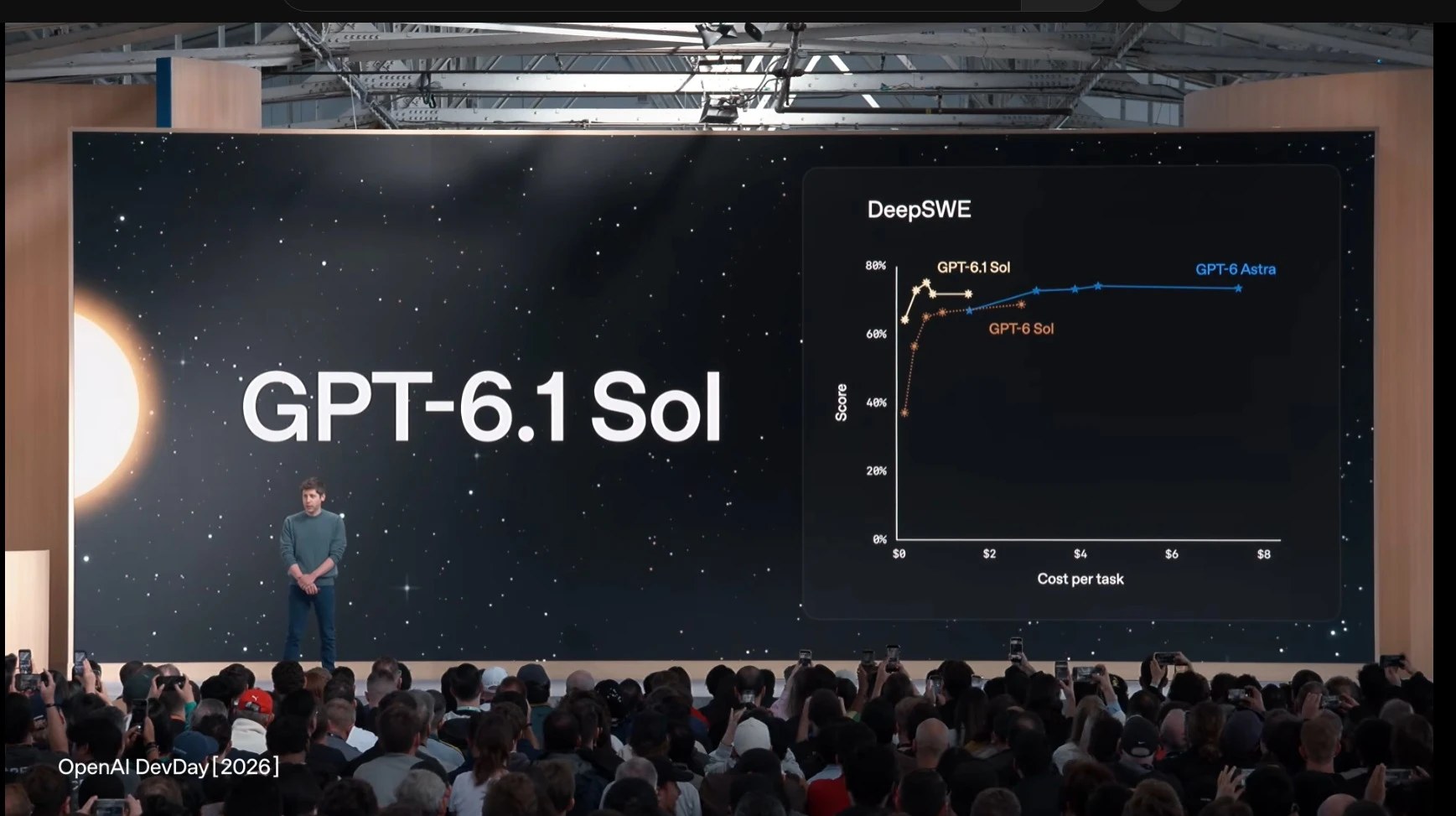
Figure: the DeepSWE cost-versus-score chart OpenAI showed in the keynote; GPT-6.1 Sol sits at a lower cost with a score that holds up against GPT-6 Astra. These are OpenAI's own numbers, so verify against your own tests. Source: OpenAI DevDay 2026 keynote.
The cost-versus-score charts OpenAI published
The three charts below are OpenAI's own numbers (cost per task on the x-axis, score on the y-axis). Treat them as a reference and re-test on your own tasks.
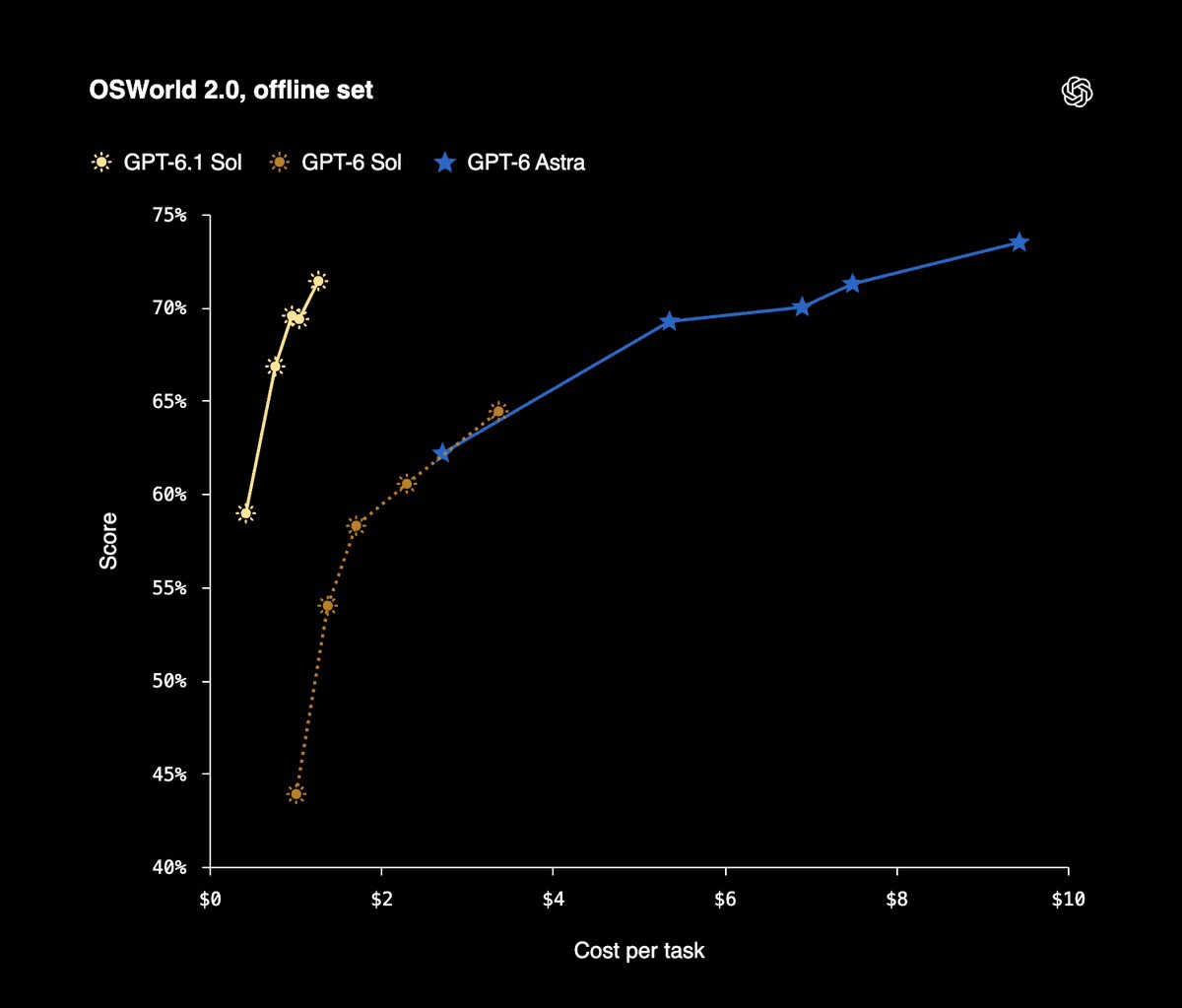
OSWorld 2.0 (offline set, computer use): GPT-6.1 Sol peaks around 71% at about $1.2 per task; GPT-6 Astra peaks around 73.5% at about $9.4; GPT-6 Sol peaks around 64.5%.
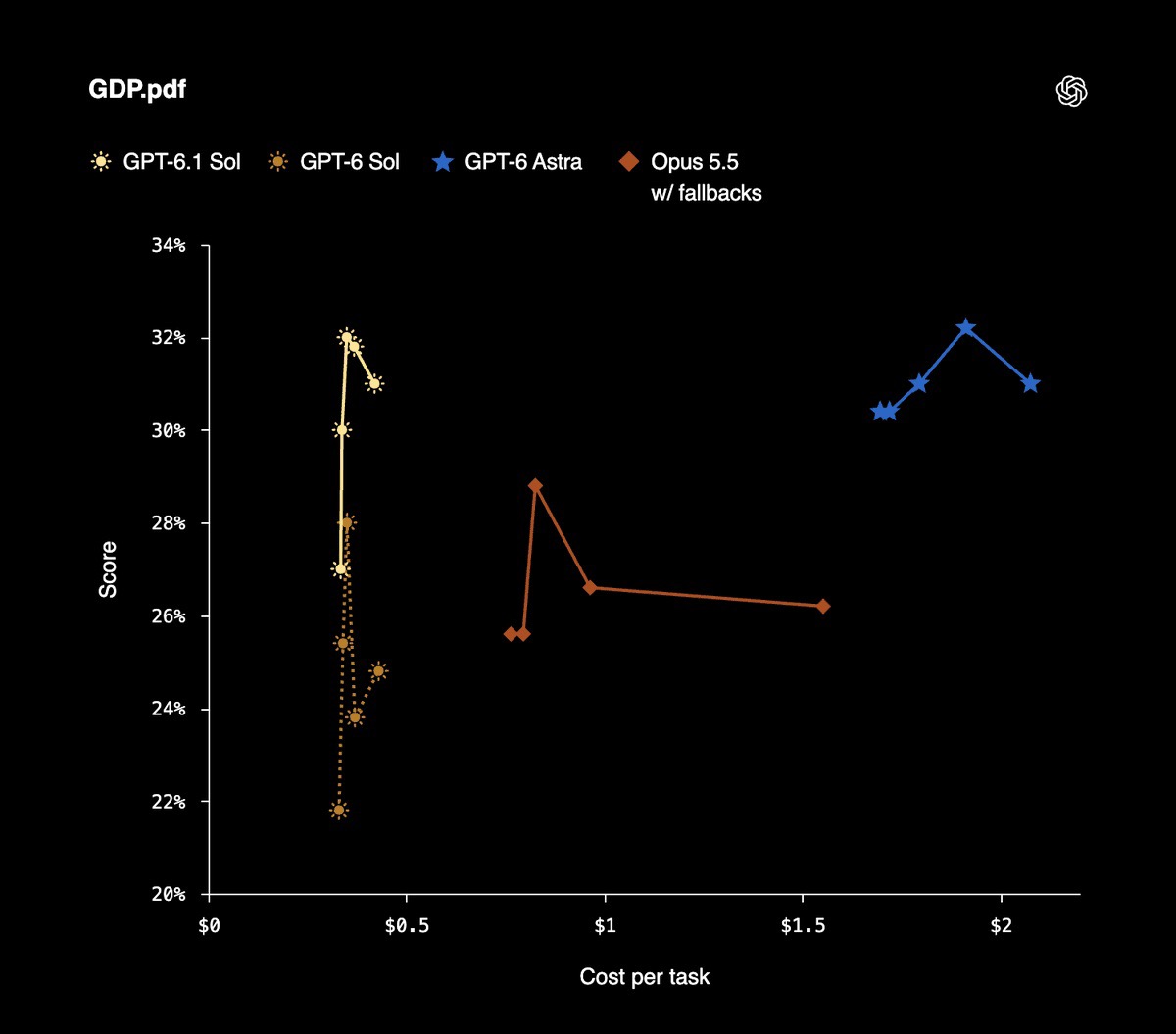
GDP.pdf: GPT-6.1 Sol scores roughly 27% to 32% at about $0.33 to $0.42 per task, close to GPT-6 Astra (roughly 30% to 32% at about $1.7 to $2.1); Opus 5.5 with fallbacks, also on the chart, scores roughly 26% to 29% at about $0.76 to $1.55.
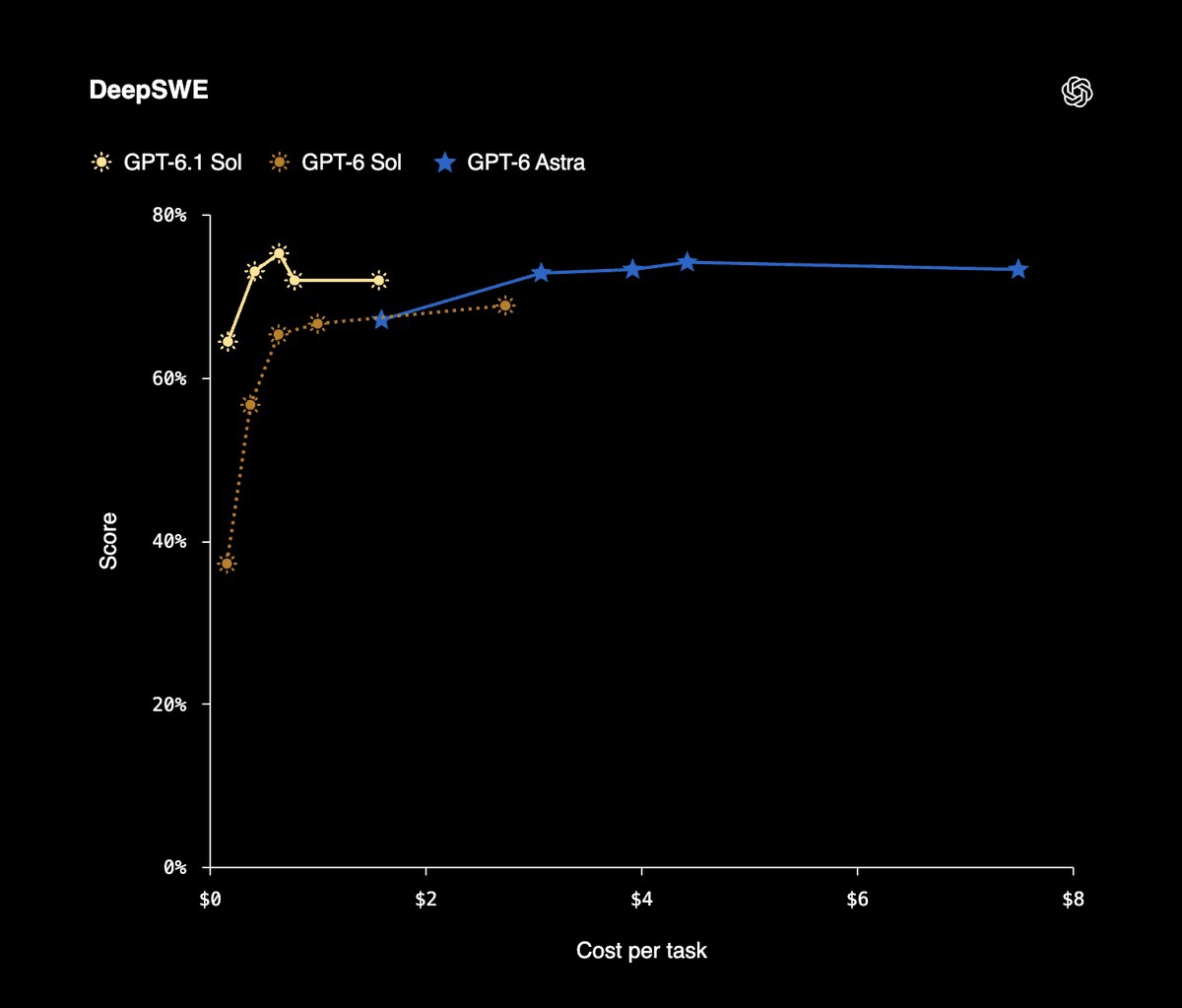
DeepSWE (software engineering): GPT-6.1 Sol peaks around 75% at under $1 per task; GPT-6 Astra is around 73% to 74% at $3 to $7.5.
Values are approximate readings from the charts. Source: OpenAI DevDay 2026.
2. Ultrafast is paying 6x for speed. It only pays off when latency directly affects experience or revenue, such as a real-time coding agent. Batch and background jobs do not need it.
3. The Decisions API is a tool for small decisions. For work that needs a single answer each time, like classification and routing, it may end up cheaper and faster than calling a large model. Pricing is not out yet, so for now it is a wait-and-see.
Subscription changes
Pro 500 is the new top plan, and Pro 200 usage was reduced at the same time. According to The Next Web, from October 30 Pro 200's included usage in ChatGPT Work and Codex drops from 20x to 10x the Plus allowance and GPT-6 Pro messages fall from 200 to 100 a week; current subscribers keep existing limits through October 29 and get a one-time $2,500 usage credit that expires at year end. We covered the effect earlier: Codex Pro $200 usage change: half the API spend. If you ran heavy Codex work on Pro 200, re-estimate your usage and decide whether to upgrade, downgrade or move to pay-as-you-go API billing.
What is the Decisions API?
It handles judgment calls with a limited set of answers. You define the question and a fixed list of possible answers, pass text or images as context, and it returns one of the options (coverage mentions confidence scores). It is not a chat model and does not write long text.
- Foundation: built on GPT-6 Luna.
- Speed: OpenAI says 150 ms, versus 1.6 s for the regular Luna API, about ten times faster.
- Uses: classifying content, routing requests, choosing an agent's next action.
- Status: limited preview, pricing not announced; coverage splits between "in the coming days" and "in a few weeks" for broad availability.
The reaction on X was blunt:
That jab points at the real idea: restricting output to a few options buys speed and a predictable format. In Every's test it also beat TypeSafe's Jev on a set of tasks (76 versus 73 points, 230 ms versus 500 ms).
What is the Agents API?
It brings Codex's agent capabilities into your own application.
- Computer Use: agents operate software on their own to finish tasks. Codex and ChatGPT have had this on macOS since April and Windows 11 since May.
- Multi-agent: a main agent hands independent work to subagents, each with its own context, running in parallel. Per the docs, the default is at most 6 at a time (
max_concurrent_subagents); subagents inherit MCP tools and web search settings but do not support custom function tools. - Tool search, tool calling and context compaction: finding tools when there are many, and compacting long conversations automatically.
- AWS: Amazon also launched Bedrock Managed Agents powered by OpenAI, running natively inside AWS.
What people are saying
- Startup anxiety: DevDay is known in AI circles as judgment day for wrapper startups, and many posts on X worry the new tools replace existing products.
- Dots: Every's author says it became his most-used ChatGPT mode but is too buggy for now (permission problems, dropped messages), so he would not rely on it yet.
- Roundup post: Wall St Engine's thread lists 19 announcements and mentions ChatGPT reaching 1.2 billion weekly users.
Video
OpenAI's official DevDay 2026 keynote:
Caveats
- Outlets disagree on Sol 6.1's relative price and on Ultrafast's token speed. We could not open OpenAI's own recap page directly at publication time, so defer to the official announcement.
- Every's hands-on found Dots too unreliable to depend on for now, citing permission problems and dropped messages.
- Prices and timelines for preview features may change.
What you can use on BazaarLink
GPT-6.1 Sol is now available: $2 input and $10 output per million tokens, $0.10 cache read, a 1.05M-token context window, and text, image and file input; the part of a prompt above 272K tokens is billed at $4 input and $15 output, matching OpenAI's published tier. The catalog also lists GPT-6 Astra ($10 input, $50 output), GPT-6 Sol ($2 input, $10 output) and GPT-6 Luna ($0.1 input, $0.5 output). The Ultrafast tier is not offered. To compare cost and quality across models see the model catalog. To have a model answer with current information, add :online to the model name; see adding web search with :online.
Sources: The Decoder, 9to5Mac, Every: Vibe Check, OpenAI DevDay 2026 recap.
TWD billing · Taiwan invoices · leading AI models · OpenAI-compatible API